Sunday, November 24, 2013

What we teach our children about driving

The other day I got an update that my new tires had arrived in my LBS. Excitedly I hopped on my bike to make the 5 mile ride. In my area I have to go about 0.75-1 mile to get to the trail, then I can take the trail strait to the shop.

The last 5 blocks before the trail are characterized by a 25mph street that runs past 2 schools. It's a classic local street, unstriped with parking on both sides. I was riding just clear of the door zone, passing kids and their parents as they left school for the day, when some lady in an SUV started honking at me. Apparently in her mind I should have been riding in the parking lane, running into cars. After I refused to move over and endanger myself (seriously there was plenty of room to pass me safely), she decided to buzz me, coming within 2 ft of my bike.

So why is it alright to act like that, in front of kids, in a school zone? Well driving seems to be an almost sacred right, and the blessed who do so are never accountable for their actions...unless they are inebriated where it becomes a maybe. A news story in 7News seems to sum this up well.


When I saw this headline, and after the recent flooding in CO, I figured this would be a story about heating going out, exposure claiming people's lives, or avalanches and flood waters whisking people away, never to be seen from again. I prepared for some bad stories, and thought about putting a space blanket in my bag. The article did outline a few deaths from the storms:
In Arizona, firefighters recovered the body of a man who was swept away by high waters Friday in the Santa Cruz River in the southern part of the state.
In California, where the storm system hit first, prompting flooding and water rescues in recent days, three deaths have been linked to the storms since Thursday, as authorities found one body near downed power lines, [...] and a woman was killed when a tree fell on a parked car.
These are sad, awful stories that should not be taken lightly. That being said, the article then devolves into blaming traffic accidents solely on weather, and not touching any issues about the driver's conduct.
Parts of the state had already been hit with snow and freezing rain that caused a rollover accident that killed a 4-year-old girl in the eastern part of the state.

Three other storm-related deaths were reported Saturday in a crash in the Texas Panhandle involving nearly a dozen vehicles.
[...]one man crashed his vehicle into a tree[...]
 and so on.

I'm sure these deaths were not helped by the weather, but to say the weather is the reason for these deaths is not honest. There is no discussion about how drivers should exercise more care, more caution or should stay off the roads altogether if it is unsafe. There is no referencing of the personal responsibility that anyone assumes when they decide to drive a 3,000 lb vehicle around.

The most frustrating line was found in the bottom half of the article:
In Arizona, more than 8,000 cyclists competed Saturday in rainy conditions in the annual El Tour de Tucson. One cyclist died in a collision with a vehicle, but there was no immediate indication that the accident was storm related.
So if it is not storm related, why is it in this piece? Were their other accidents from the event? In my mind the bigger issue is, why did an automobile hit a cyclist during an event? It would seem to me to be a much bigger issue if a cyclist strayed into oncoming traffic, or if the vehicle hit and killed a cyclist.

But no, there is no discussion about how to act in weather. I take from this that if I am out and it snows or rains, I can blame everything that happens on the weather. Lets start now and make it easy for the cops. There was snow on the ground, so this tragedy was the fault of mother nature.

Hey, at least it's not Florida, where it seems that the only reason to start to investigate a crash resulting from driver neglect is when the driver admits to being drunk. I hope she finds herself in jail for a while, in AA and without a license for the remainder of her life.


Saturday, November 23, 2013

Jeffco Commissioners bash cyclists, don't know the facts.

I'm in favor of segregated lanes for bikes. They are safe, and a great way to encourage people to ride. Unfortunately, the idea of even slapping some paint down on roads garners increased contention.


Some amazing quotes from the article.

Commissioner Rosier said he was not supportive of adding bike lanes on Bowles and questioned the validity of public meetings, saying, "They will be weighted." He said, "I receive way too many complaints, especially from Deer Creek on 'Why are we putting lanes in for cyclists?' "
He said, "It's taking away from motorist capacity. We don't have the bike commuter traffic. This is spending money to address an issue that doesn't exist."

[Commissioner] Griffin said, "I get tired of the fact that bicyclists are telling us what to do with the roads that they don't help pay for."
This is an argument that  is used often, and typically are used incorrectly. Yes, there are registration fees, and gas taxes. Yes, these taxes are used in part for road construction and maintenance. But to say that cyclist don't pay is simply ridiculous and provably incorrect. Just from the 2012 Jeffco Budget (as posted here), we can find the following sources of funding for roads.
  • Jeffco allots a percentage of property tax to roadway construction and repair, regardless of your ownership or use of an automobile:
    • Road & Bridge Fund - 110
      The Road & Bridge Fund accounts for monies generated by property taxes and other sources and expended for highway and street maintenance and repair.
  • Jeffco allots a percentage of their sales tax to roadway construction and repair, regardless of your ownership or use of an automobile.
    • South East Sales Tax-Capital Projects Fund - 381
      The South East Sales Tax - Capital Projects Fund accounts for the financial resources used for the construction of street improvements within a portion of the southern unincorporated boundaries of the County.
  • Jeffco pays for roadway construction and repair from it's general fund, which is made up of taxes collected that have nothing to do with automobile ownership or usage.
Add this to the fact that studies have shown:
  • That the damage done to roadways by 1 automobile is roughly equivalent to that done by 10,000 bikes.
  • People who exercise 30 mins a day reduce their chances of heart disease by 50%, exercise reduces the levels of cholesterol in one's blood, decreases the chance of having a heart attack or stroke, and reduces the possibility of needing bypass surgery.
    • This has the side effect of lowering health premiums for both the cyclist and the rest of the pool of insured people.
  • People who regularly exercise also take less sick days, are more efficient at work, and cyclists are better shoppers.
Despite all this we are still supposed to believe that cyclists don't pay for roads. In fact, recent studies in other cities have shown that cyclists and pedestrians OVER-pay for road expenses as compared to automobile users.

303cycling and bikejeffco have been two of the groups calling for people to show up to the town halls and voice their displeasure with the commissioners. I hope they can get through to the obvious anti-cyclist commissioners and move forward with more and improved cycling infrastructure.

Friday, November 22, 2013

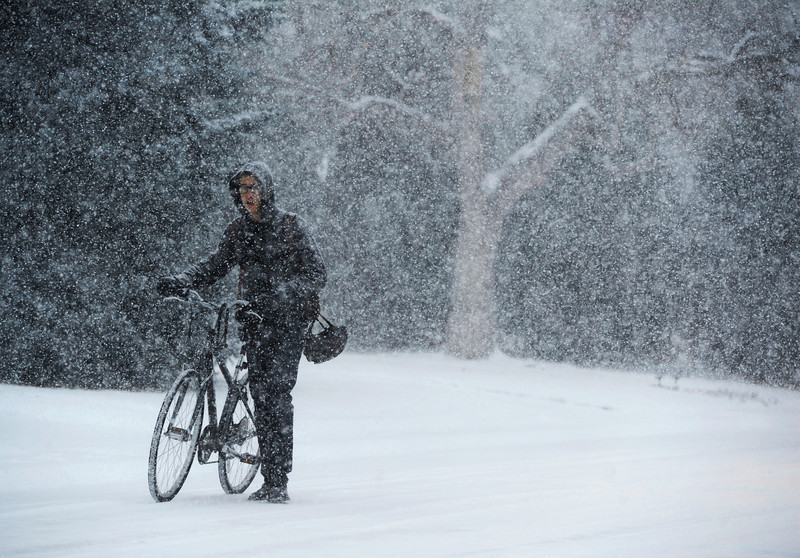
First good snowfall in Denver

Typically riding in the city in Denver is a great chance to race some cars and exchange heated words with motorists who don't know the laws. It's almost therapeutic when you get to have righteous anger, the kind where you know you are right and the world is wrong. It's almost fun. When the snow comes though, some of the fun turns more monotonous. Racing traffic becomes commuting, and the once wide streets become a fight over 3 ft of clear road. 

This winter Denver is set to try to attract more cyclists to venture out. Not only will B-cycle be open year round (awesome), but Denver Public Works may try to actually clear some bike lanes. Though not without telling people to not actually bike. After the first real snowfall of the year, I have to say that their plan should be expanded.
As listed on  their site, they will "attempt" to not push snow into lanes on Tejon in the NW, 17th  in the East, Florida in the southwest, MLK in the east, and 16th ave in cap hill. I suppose this star pattern is efficient for commuters, but it would be nice to see actual assurances. It would also be nice to see more lanes cleared to promote biking by not forcing people to add miles to their rides.
The bike network in Denver is sparse enough as is, even given the call by tech companies for more bike infrastructure. The 15th st. bike way is a...start, but without anything but some paint, it offers no real protection from traffic. Couple this with the city only saying that it will "make every effort" to clear the lanes, and you are left with not fun racing of traffic, but being corralled into the lines of loud polluting vehicles.
It looks like Denver Public Works will have it's hands full, and commuters will be dodging ice this week.


Photo courtesy of  Andy Cross from The Denver Post